
03 May 2022 – When covering the publication of the IPCC 2022 Climate Change Report, The Guardian’s succinct headline read “The World can still hope to stave off the worst ravages of climate breakdown but only through a ‘now or never’ dash for a low-carbon economy.” As rising atmospheric CO2 levels make it ever more difficult to avoid catastrophe, what will it take to turn our societies around fast enough.
Policies required to reach sustainability are seen, by governments and public alike, as unwelcome and unwanted, requiring a lowering of material living standards. Tackling the environmental crisis is regarded as marking the end of the desired high consumption lifestyles of rich countries and demanding that people give up many of the things they enjoy – flying less, eating less meat, swapping the convenience of private cars for public transport, with the nuisance of using less plastic, having to recycle waste or to repair goods rather than replacing them with new, added on for good measure.
Against this, the voices of environmentalists expressing the hope that it is possible to create a carbon neutral future which is cleaner, safer and achieves higher levels of health and wellbeing, go almost unheard. Yes, we can amplify those voices but, when faced with policies to guide change, such as higher taxes on fossil fuels for example, the distant and uncertain prospect of a better tomorrow does not feel like bankable compensation.
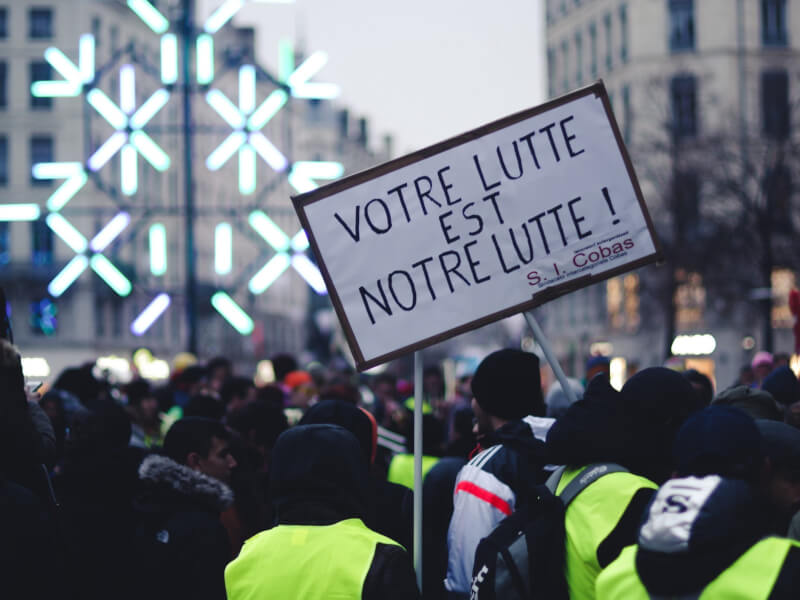
But we overlook another crucial issue. When President Macron proposed to raise fuel taxes in France, the plan was greeted with what was probably the strongest wave of civil unrest in France since the May 1968 uprising. Under the banner of the apparently leaderless Gilets Jaune movement, every weekend for many months saw rioting and blocked roads in hundreds of places all over France. Even after cars were burned and buildings ransacked, opinion polls suggested that almost three-quarters of the French population still supported the demonstrators. Eventually, the planned fuel price rises had to be withdrawn before they were implemented.
People felt that flat rate fuel price rises were unfair, indeed, fairness became the focus of the Gilets Jaune movement – from the unfairness of the tax system to the stark contrast between the rich elite and ordinary people. A New York Times reporter described the protests as a “venting of rage and resentment by ordinary working people, aimed at the mounting inequalities which have eroded their lives”. Other reports described the “evident joy in smashing up the grandest and wealthiest” parts of Paris.
But rather than blocking our path to sustainability, the desire for greater equality has to be recognized as essential to making the transition. There is a close parallel with Britain’s transition to a war economy at the onset of the second world war. In order to gain public support for the war effort, it was regarded as essential to make the burden of war seem equally shared. Key was the introduction of rationing, making income taxes much more progressive, putting taxes on luxuries and subsidies on necessities. Even the royal family was included.
If we are to make the transition to zero carbon by 2050, we will need to create the same sense of pulling together in response to an emergency. Without that many people will oppose the policies needed to produce change. And how could it be otherwise – given that the average emissions of someone in the richest 10% of the world’s population are estimated to be around 20 times those of one of the poorest 50% or, as Oxfam estimated, the total carbon emissions of the world’s richest 1 percent are more than double the emissions of the poorest half of humanity?
The consumption of the rich, however, has much wider and more damaging effects; it effects the aspirations of the rest of the population. Income may not trickle down, but desires do. Studies have shown that living in societies with bigger income difference leads to increases in people’s expenditure on status goods such as expensive cars or clothes with designer labels. As a result, both household debt and bankruptcies increase with inequality.
By making class and status more important, inequality increases what might be called the ‘pressure to consume’ – a crucial obstacles to sustainability.
Rather than allowing the sense of unfairness to be an obstacle to carbon neutrality, as when the Gilets Jaunes made Macron abandon environmental policies, reducing inequality must be recognized as the way to galvanize a commitment to change. If we don’t make it work for people, we won’t make it work for the planet.
Earth4All Deep Dive 01: From inequality to sustainability